
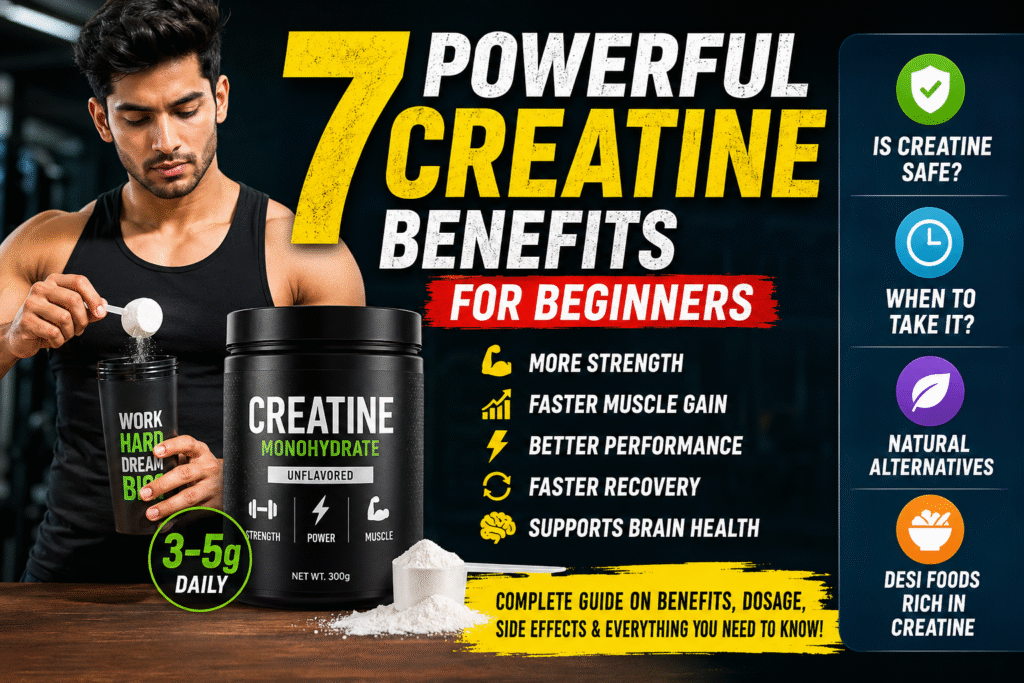
Creatine Benefits for Beginners – Suppose you’ve recently joined a gym, chances are you’ve heard someone talking about creatine. Walk into any fitness center, and you’ll find experienced lifters recommending it as one of the most effective supplements for building strength and muscle.
But what exactly is creatine? Is it safe? Should beginners use it? What are its side effects? And are there any natural alternatives available?
In this comprehensive guide, you’ll learn everything you need to know about creatine so you can make an informed decision about whether it’s right for you.
Table of Contents
What Is Creatine?
Creatine is a naturally occurring compound found in your muscles and brain. Your body produces small amounts of creatine from amino acids, and you also obtain it through foods such as meat and fish.
Approximately 95% of the body’s creatine is stored in skeletal muscles, where it helps produce energy during high-intensity activities.
Whenever you perform explosive exercises such as weightlifting, sprinting, jumping, or intense sports, your muscles rely on a molecule called ATP (Adenosine Triphosphate) for energy. Creatine helps replenish ATP quickly, allowing your muscles to continue performing at a high level. This is the primary reason why athletes and gym-goers use creatine supplements.
7 Powerful Benefits of Creatine for Beginners
1. Increases Strength and Power
One of the biggest reasons people take creatine is its ability to increase strength.
Research consistently shows that creatine supplementation can help improve:
- Bench press performance
- Squat strength
- Deadlift numbers
- Sprint performance
- Overall power output
For beginners, this means you may be able to perform more repetitions and lift slightly heavier weights, leading to faster progress.
2. Supports Muscle Growth
Creatine helps draw water into muscle cells, making muscles appear fuller and larger.
More importantly, the increase in training performance allows you to challenge your muscles more effectively over time, which contributes to greater muscle growth. Combined with proper nutrition and progressive overload, creatine can significantly support muscle-building goals.
3. Improves Workout Performance
Fatigue often limits workout quality.
Because creatine improves your body’s ability to regenerate ATP, you may experience:
- Better training intensity
- Increased workout volume
- Enhanced endurance during resistance training
- Improved recovery between sets
This allows beginners to get more out of each training session.
4. Enhances Recovery
Intense workouts cause microscopic muscle damage that requires recovery.
Studies suggest creatine may help reduce exercise-induced muscle damage and inflammation, potentially leading to faster recovery between workouts.
This can help beginners maintain consistency in their training routine.
5. Helps Build Lean Muscle Mass
Unlike steroids, creatine does not artificially alter hormones.
Instead, it supports natural muscle development by:
- Increasing training capacity
- Improving strength
- Supporting recovery
- Enhancing muscle hydration
These factors work together to promote lean muscle gain.
6. May Support Brain Function
Recent research has explored the role of creatine beyond athletic performance.
Some studies suggest that creatine may help:
- Improve memory
- Support mental performance during sleep deprivation
- Enhance cognitive function
Although more research is needed, these findings are promising.
7. One of the Most Studied Supplements in the World
Many supplements enter the market with little scientific evidence.
Creatine is different.
Hundreds of scientific studies have examined its effectiveness and safety over several decades, making it one of the most trusted sports nutrition supplements available.
This is one of the most common questions among beginners.
The answer is yes.
For healthy adults, creatine monohydrate is considered safe when taken at recommended doses.
Research has repeatedly shown that creatine does not harm healthy kidneys, liver, or heart when consumed responsibly.
However, individuals with existing kidney disease or other medical conditions should consult a healthcare professional before supplementation.
Common Myths About Creatine
Myth #1: Creatine Is a Steroid
This is completely false.
Creatine is not an anabolic steroid and does not affect hormone levels in the same way steroids do.
It is a naturally occurring substance found in the body and various foods.
Myth #2: Creatine Causes Kidney Damage
For healthy individuals, scientific evidence does not support this claim.
Long-term studies have shown no harmful effects on kidney function when recommended dosages are followed.
Myth #3: Creatine Causes Hair Loss
Current evidence remains inconclusive.
There is insufficient scientific proof that creatine directly causes hair loss.
Myth #4: You Must Cycle Creatine
Unlike many supplements, creatine does not require cycling.
You can take it consistently year-round if desired.
Potential Side Effects of Creatine
Although creatine is generally safe, some people may experience mild side effects.
Water Retention
The most common side effect is increased water retention within muscle cells.
This can lead to:
- Fuller muscles
- Slight weight gain
- Improved muscle appearance
Digestive Discomfort
Taking large doses at once may cause:
- Bloating
- Stomach discomfort
- Diarrhea
These symptoms are usually avoided by sticking to 3–5 grams per day.
Temporary Weight Gain
Many users gain 1–3 kilograms initially due to increased water content in muscles.
This is not body fat.
When Should You Take Creatine?
One of the biggest misconceptions is that timing is critical.
In reality, consistency matters far more than timing.
Before Workout
Some people prefer taking creatine before training.
Benefits include convenience and habit formation.
After Workout
Many fitness experts recommend taking creatine after exercise alongside a protein shake or meal.
Post-workout nutrition may help optimize nutrient uptake.
The Best Approach
For beginners:
- Take 3–5 grams daily.
- Consume it at a time you can remember consistently.
- Continue taking it even on rest days.
Consistency is the key to success.
How Much Creatine Should Beginners Take?
The most effective and researched form is Creatine Monohydrate.
Standard Daily Dose
- 3–5 grams per day
Loading Phase (Optional)
Some people choose to load creatine by taking:
- 20 grams daily for 5–7 days
Followed by:
- 3–5 grams daily
However, loading is not necessary. Regular daily intake will eventually produce similar results.
Natural Sources of Creatine
Many people prefer obtaining nutrients through food.
Natural creatine sources include:
Fish
Fish such as salmon and tuna contain naturally occurring creatine.
Red Meat
Beef and mutton are among the richest dietary sources.
Chicken
Chicken also contributes moderate amounts of creatine.
However, obtaining 3–5 grams of creatine solely from food would require consuming large amounts of meat daily.
Desi Alternatives to Creatine
There is no true natural Indian substitute that works exactly like creatine.
However, some traditional options may support fitness goals.
Ashwagandha
Ashwagandha may help:
- Reduce stress
- Improve recovery
- Support strength gains
Shilajit
Shilajit is commonly used to support:
- Energy levels
- Vitality
- Overall wellness
High-Protein Indian Foods
Focus on foods such as:
- Paneer
- Milk
- Curd
- Soy chunks
- Moong dal
- Chana
- Rajma
These foods support muscle growth but do not replace creatine’s function.
Should Beginners Take Creatine?
Creatine may be beneficial if:
- You train consistently.
- You want to gain strength.
- You want to build muscle.
- You participate in high-intensity sports.
You may not need creatine if:
- You rarely exercise.
- Your fitness goals are limited to casual activity.
You have medical conditions requiring professional supervision.
Final Verdict
Creatine remains one of the safest, most effective, and scientifically supported supplements available today.
For beginners, it can improve strength, workout performance, recovery, and muscle growth when combined with proper training and nutrition.
However, remember that creatine is not magic.
Your results will primarily depend on:
- Consistent training
- High-quality nutrition
- Adequate protein intake
- Proper hydration
- Sufficient sleep
If those fundamentals are already in place, creatine monohydrate can be a valuable addition to your fitness journey and may help you achieve your goals more efficiently.
FAQs for Creatine Benefits for Beginners
1. Is creatine safe for beginners?
Yes, creatine monohydrate is generally safe for healthy beginners when taken at recommended doses.
2. When should I take creatine?
You can take creatine before or after workouts. Consistency matters more than timing.
3. Does creatine cause kidney damage?
Research shows no evidence of kidney damage in healthy individuals using recommended doses.
4. Can vegetarians take creatine?
Yes. In fact, vegetarians may experience noticeable benefits because their dietary creatine intake is often lower.
5. What is the best form of creatine?
Creatine monohydrate is the most researched, effective, and affordable form.
6. Is there a natural alternative to creatine?
There is no exact natural substitute. Meat and fish are the closest natural sources, while Ashwagandha and Shilajit may support overall fitness differently.
Related Articles:-
7 Ayurvedic Morning Drinks for Better Digestion and Energy
Top 10 Superfoods for Weight Loss and Muscle Growth
10 Proven Benefits of a Balanced Diet for Everyday Energy
10 Best Protein Powders for Weight Loss and Gain Muscles in 2026