
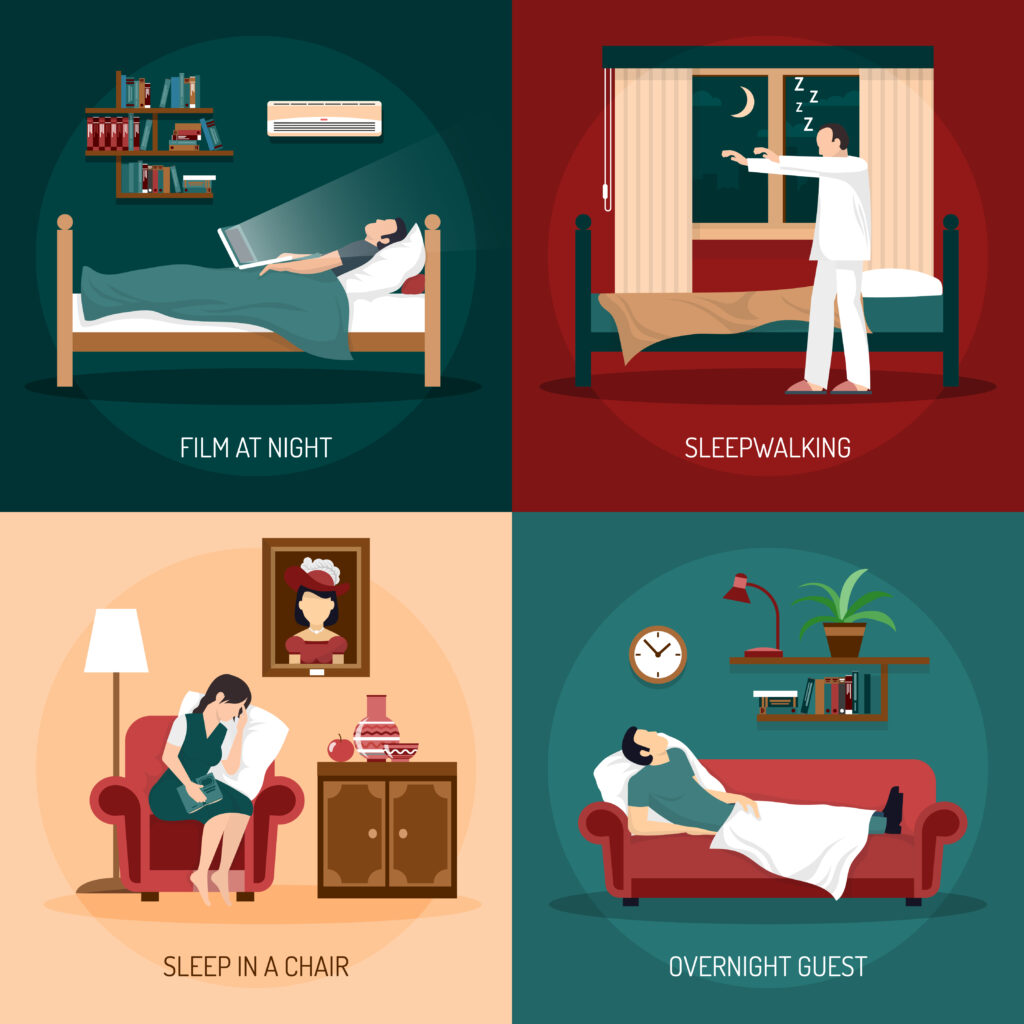
Insidious Bedroom Habits That Make You Wake Up Tired:- You wake up. The alarm is blaring. Your eyelids feel like they are made of lead, and a foggy weight has settled over your brain. You glance at your smartwatch—seven and a half hours. By all accounts, you should be rested. But you aren’t. You are exhausted.
This scene is a daily reality for millions of people. For a long time, the public health conversation around sleep has focused purely on quantity. We are told we need seven to nine hours of sleep, and if we hit that number, we are doing fine. However, modern sleep science tells a different story. Good health isn’t just about how long you sleep; it’s about how well you sleep. It’s about sleep quality.
If you are getting enough hours but still waking up sluggish, irritable, and craving caffeine by 10:00 AM, something is sabotaging your sleep architecture from within your own bedroom. “Sleep architecture” refers to the structure of your sleep cycles, specifically the balance between Light Sleep, Deep Sleep (vital for physical restoration), and REM sleep (essential for memory and emotional regulation).
Many of us have developed seemingly harmless, cozy, or convenience-driven routines that are, in fact, insidious killers of sleep quality. They don’t necessarily keep you wide awake, but they fragment your sleep, reduce deep sleep stages, and prevent your body from performing its necessary nightly repairs. Here are five insidious bedroom habits that are ruining your rest, and exactly how you can fix them to finally wake up feeling refreshed.
Table of Contents
Insidious Bedroom Habits no 1: Treating Your Smartphone Like a Nightlight (The Blue Light Trap)
It is the most common modern habit: hopping into bed, turning off the lights, and pulling out the phone for one last scroll through social media, news, or email. It feels like a way to wind down, but physiologically, you are doing the exact opposite.
Why It Is Insidious:
This habit attacks your sleep on two distinct fronts: chemical and psychological.
Firstly, your digital screens (phones, tablets, laptops) emit a specific wavelength of artificial blue light. Our brains are designed to be extremely sensitive to this light because it mimics sunlight. When this light enters your eyes in the evening, your brain—specifically the suprachiasmatic nucleus (your master clock)—thinks it is daytime. As a result, it suppresses the production of melatonin.
Melatonin is the hormone responsible for signaling to your body that it is time to wind down and go to sleep. By scrolling in bed, you are essentially telling your body to stay alert, pushing back your natural sleep onset and reducing the overall time your body has for restorative sleep stages. Even if you use “night mode,” the light is often still bright enough to disrupt melatonin.
Secondly, the content you consume matters. Checking work emails causes stress; scrolling news can cause anxiety; social media can trigger FOMO (Fear Of Missing Out) or social comparison. These activities activate your sympathetic nervous system—the “fight or flight” response—increasing your heart rate and cortisol levels. You cannot fall into a high-quality sleep when your body is physiologically prepared to fight a tiger.
The Fix: The Digital Sunset
Create a strict “Digital Sunset” rule. All screens should be turned off at least one hour before your intended bedtime. Charge your phone across the room or, ideally, in another room entirely. If you use your phone as an alarm, buy a dedicated alarm clock. This removes the temptation to check “just one more thing” when you are struggling to fall asleep.
Habit 2: The Bedroom Thermostat War (The Room is Too Warm)
Many people prefer a cozy, warm bedroom, especially during colder months. You might pile on blankets or keep the heating high to make the room feel comfortable. While this might feel pleasant when you are climbing into bed, it is often too hot for high-quality sleep.
Why It Is Insidious:–
Your core body temperature plays a crucial role in your sleep cycle. About one to two hours before bedtime, your body begins to drop its core temperature. This drop is a powerful circadian signal to the brain that sleep is approaching. Throughout the night, your body continues to need to expel heat to remain in deep sleep stages.
If your bedroom temperature is too high (typically above 71°F or 22°C), your body cannot effectively expel that heat. This causes restlessness, tossing and turning, and significantly reduces the amount of time you spend in Deep Sleep and REM sleep. You might not wake up fully, but your body is working too hard to regulate its temperature to enter the most restorative phases of rest. You will wake up feeling physically tired because your body never got its chance to fully repair itself.
The Fix: Cool It Down
According to the National Sleep Foundation and various sleep experts, the optimal bedroom temperature for sleep is between 60 and 67°F (15.6 and 19.4°C). This might feel cool initially, but your body will adapt, and you can use blankets to regulate comfort. The goal is to keep your core cool while your skin feels comfortably warm.

Habit 3: The Evening “Nightcap” (The Alcohol Deception)
It’s a classic trope: using a glass of wine, a beer, or a spirits drink to “take the edge off” and help you fall asleep faster. Alcohol is a sedative, and it absolutely works to reduce the time it takes you to fall asleep (sleep onset latency). However, its effect on sleep architecture is disastrous.
Why It Is Insidious:
Because alcohol helps you fall asleep, you perceive it as a sleep aid. This is the deception. As your body begins to metabolize the alcohol throughout the night, its sedative effect wears off. About midway through the night, you hit what sleep science calls the “rebound effect.”
While you are sleeping off the alcohol, your body experiences a withdrawal-like state. This fragments your sleep architecture. Critically, alcohol severely suppresses REM sleep, especially in the first half of the night. REM sleep is vital for cognitive functions like memory consolidation and emotional regulation.
Furthermore, the rebound effect causes increased wakefulness and lighter sleep in the second half of the night. You may wake up multiple times to urinate (alcohol is a diuretic) or experience night sweats as your metabolism spikes to clear the toxin. The result is a night of fragmented, shallow sleep. You might have slept for eight hours, but the quality was extremely poor, leaving you with that classic “hungover” fogginess, even from a single drink.
The Fix: Time Your Drinks
You don’t necessarily have to eliminate alcohol, but you must time it correctly. If you want a drink, have it with dinner, rather than as a “nightcap” right before bed. Aim to have your last drink at least three to four hours before you plan to sleep. This gives your body enough time to metabolize most of the alcohol before you need to enter deep, restorative sleep.
Habit 4: Treating Your Bed Like a Multi-Purpose Office/Entertainment Hub
In the age of remote work and streaming services, the bedroom has increasingly become a second living room or office. We answer emails in bed, watch entire Netflix series in bed, do our taxes in bed, and sometimes even eat in bed. It’s convenient, cozy, and seemingly harmless.
Why It Is Insidious:
This habit destroys the powerful psychological association your brain needs to have with your sleep environment. Your brain is a masterpiece of classical conditioning. If you consistently do active, stressful, or highly stimulating activities in bed, your brain learns that “bed = place for alertness.”
When you finally turn off the laptop or the TV and try to sleep, your brain doesn’t receive the “it’s time to rest” signal. Instead, it remains in an active state, ready to work or be entertained. This can lead to condition called Psychophysiological Insomnia, where the very act of lying in bed makes you feel alert and anxious about not sleeping. You end up tossing and turning, not because you aren’t tired, but because your brain has been trained to remain awake in that specific environment.
The Fix: The Bed is for Sleep and Sex Only
Re-establish strict boundaries for your bedroom, and specifically your bed. The bed should be reserved exclusively for sleep and intimacy. Do not work, watch TV, play video games, eat, or argue in bed. By doing this, you are conditioning your brain so that when your body hits the mattress, the brain automatically begins to trigger the relaxation and sleep-onset process. If you cannot sleep after 20 minutes, get out of bed and do something boring in another room until you feel sleepy again, then return. Do not train your brain to be awake in bed.
Habit 5: The “Sleep Junkie” Mindset (Bedroom Overthinking and Worry)
This habit isn’t an object you use, but a cognitive routine you perform. As soon as your head hits the pillow, your brain decides it is the perfect time to review every social interaction you had that day, plan your entire schedule for the next week, resolve that argument you had five years ago, and worry about the state of the world.
Why It Is Insidious:
This is “rumination” and “cognitive arousal,” and it is the enemy of sleep. The transition from wakefulness to Light Sleep requires your brain waves to slow down from active Beta waves to Alpha and eventually Theta waves. Rumination keeps your brain locked in a high-frequency Beta state.
When you ruminate in the bedroom, you are activating your brain’s “problem-solving” mode, which often triggers the release of stress hormones like cortisol and adrenaline. Even if you manage to fall asleep, high cortisol levels can prevent you from dropping into the deepest, most physically restorative stages of sleep. You might get your eight hours, but because your nervous system remained slightly “on edge,” you wake up feeling like you’ve been working all night—because, cognitively, you have.
The Fix: The Brain Dump and Worry Time
You cannot simply order your brain to stop thinking. Instead, you need to manage those thoughts before you enter the bedroom.
The Brain Dump: Keep a notebook by your bed (or better, in another room). Before you start your wind-down routine, spend five minutes writing down everything that is on your mind: to-do lists for tomorrow, worries, unresolved thoughts. By physically writing them down, you are signaling to your brain that they are captured and do not need to be actively processed while you sleep.
Scheduled Worry Time: If you are a chronic worrier, schedule 15 minutes in the afternoon to ruminate. Give yourself permission to worry fully during that time. If a worry pops up in bed, tell yourself: “I will worry about this tomorrow at 4:00 PM.”
Conclusion: Total Bedroom Optimization
Waking up tired when you feel you’ve “done everything right” is incredibly frustrating. But the reality is that high-quality sleep doesn’t just happen; it must be cultivated. It requires a commitment to your body’s circadian biology rather than your convenience or habits.
These five insidious habits—blue light, high temperatures, alcohol use, bedroom multi-tasking, and rumination—all share a common thread: they keep your nervous system alert when it should be winding down. They don’t necessarily make you “sleepless,” but they make your sleep worthless.
By identifying which of these killers of sleep quality is present in your bedroom and taking the disciplined steps to correct them, you can finally restore your sleep architecture. You are not just aiming for eight hours of time in bed; you are aiming for eight hours of true, restorative, high-quality rest. Your energized, focused, and refreshed self is waiting for you on the other side.
Related Articles:-
How to Wake Up at 5 AM Without Feeling Like a Zombie
The Military Method: How to Fall Asleep in Under 2 Minutes
Why You’re Tired All the Time (Even After 8 Hours of Sleep)
Morning Routine That Actually Boosts Your Energy
How Better Sleep Helps to Lose Weight Faster. Does it works?
[…] 5 Insidious Bedroom Habits That Make You Wake Up Tired […]