
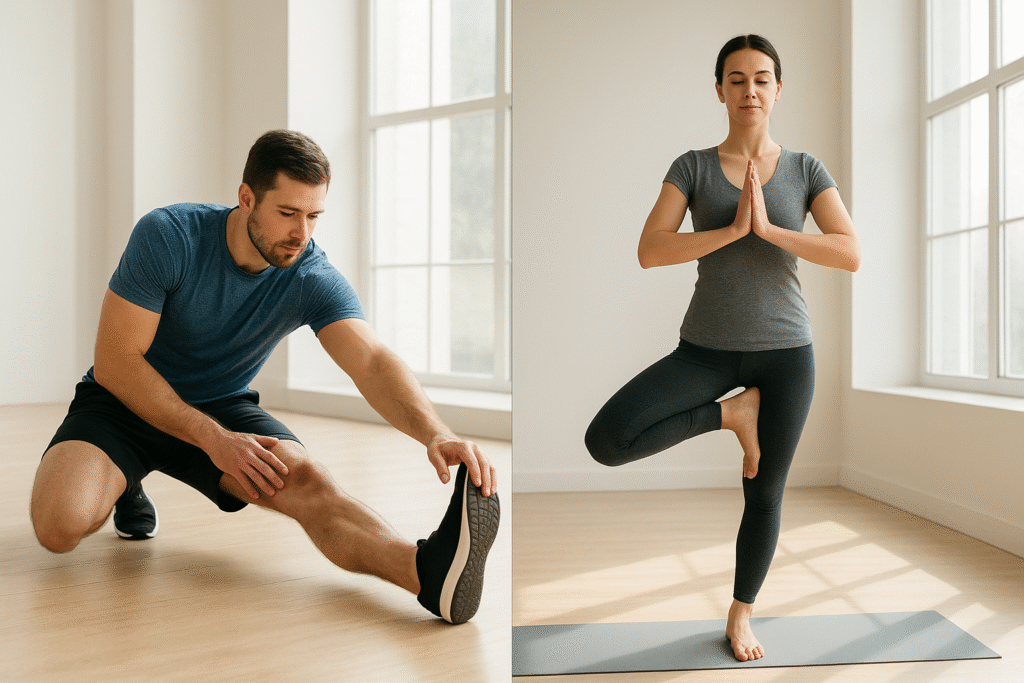
When it comes to boosting your flexibility, you’ve likely encountered two big contenders: traditional stretching and the flowing practice of yoga. But which one truly reigns supreme when it comes to improving how your body moves, bends, and holds itself? In this article, we’ll dig deep into the stretching vs yoga flexibility debate — giving you the real evidence, clear guidance, and simple ways to decide what’s right for you. At BuzzingHub.com, our mission is to bring you trustworthy, practical insights grounded in research so you can move better, feel stronger, and build lasting results.
Table of Contents
1. What is Flexibility — And Why It Matters
Flexibility refers to your body’s ability to move a joint through its full range of motion. The National Institute on Aging describes flexibility as a key part of physical ability, making everyday movements — from tying your shoes to reaching for items — much easier. Less flexibility can lead to stiffness, reduced mobility, and even increased risk of injury or falls. So whether we choose stretching or yoga, the goal is consistent: enhance your range of motion, preserve function, and promote better movement.
2. What is Stretching? (Stretching Fundamentals for Flexibility)
Stretching is the practice of deliberately elongating a muscle or tendon to increase elasticity and improve the ability of the joint to move through its full range. According to the Mayo Clinic, “stretching is an important part of any exercise program … it helps your joints move through their full range of motion.”
There are a few common types:
- Static stretching – holding a muscle at its furthest point for a period (e.g., hamstring stretch).
- Dynamic stretching – moving parts of your body and gradually increasing reach/speed.
- Active or PNF (proprioceptive neuromuscular facilitation) – using contraction and relaxation of muscles to deepen the stretch.
Benefits of Stretching
- Supports improved flexibility and joint range of motion.
- Can enhance everyday functional movements (e.g., bending, reaching).
- Aids in loosening muscle tension and promoting relaxation after workouts.
Limitations
- Some research suggests that while stretching improves flexibility over time, it may not significantly prevent injuries in some settings.
- Stretching “cold” muscles or bouncing into stretches can increase risk of harming rather than helping.
3. What is Yoga?
Yoga for Flexibility – More Than Just Stretching
Yoga is a holistic practice that combines physical postures (asanas), breathing (pranayama), and often mindfulness/meditation. Many yoga poses focus on flexibility, balance, and mobility. Importantly, yoga is frequently listed by health authorities as one of the flexibility-promoting movements.
What makes yoga unique vs. classical stretching:
- It often involves holding poses that challenge both flexibility and strength (balance, stabilisation).
- Incorporates breath control and mindfulness, which may enhance muscle relaxation and body awareness.
- Presents flexibility exercises in flowing sequences and sometimes whole-body integration (not purely isolated muscle groups).
Benefits of Yoga for Flexibility
- Improves flexibility and joint range of motion over time — especially when done regularly.
- Supports balance and mobility — the American Heart Association notes yoga as a flexibility exercise that can help everyday movement and avoid discomfort. www.heart.org
- May help reduce stress and tension, which can indirectly benefit muscle elasticity and posture.
Limitations
- Some yoga styles may lean more toward strength or cardio rather than deep flexibility-work.
- Flexibility improvements may be slower or require sustained commitment compared with simple stretching routines.
- Proper form and guidance matter — incorrect or rushed poses can lead to strain or injury.
4. Stretching vs Yoga for Flexibility — The Comparison
Stretching vs Yoga Flexibility — Which Is Better?
Let’s compare these two in key areas:
| Feature | Stretching | Yoga |
| Focus on isolated muscle/tendon | ✅ Yes | ✅ Often yes, but also full-body integration |
| Adds strength/stabilisation component | ❌ Minimal | ✅ Yes (many poses engage muscles) |
| Requires breath/mind-body linkage | ❌ Not always | ✅ Yes |
| Accessible for quick use (5-10 mins) | ✅ Yes | ✅ Yes, but some sessions longer |
| Evidence for everyday flexibility improvement | ✅ Moderate (see Mayo Clinic, VA) Veterans Affairs | ✅ Moderate-to-good (via yoga studies) |
| Best for holistic wellness (flexibility + strength + mind) | ❌ Limited | ✅ Strong |
So, which one “wins”?
It depends on your goal:
- If your main priority is “improve a specific tight muscle or joint quickly”, a targeted stretching routine may be more efficient.
- If you aim for “overall flexibility plus strength, mobility, body awareness and wellness”, yoga tends to offer a more comprehensive package.
- For long-term, sustainable mobility, combining both may be the ideal approach: use stretching for quick release and yoga for deep integration.
5. How to Decide What’s Right for You,”Stretching vs Yoga“
Evaluate Your Needs & Preferences
Ask yourself:
- Do I have a specific muscle-group tightness (e.g., hamstrings, hips) I want to fix? → Stretching might be quicker.
- Do I want a broader movement practice that includes flexibility, balance, strength, and mental calm? → Yoga is a good fit.
- Do I have time for both? → Great! A combo approach yields high benefit.
Sample Routines for Flexibility Gains
- Stretching routine (10 mins): 30-second static holds on hamstrings, hip flexors, calves, shoulders; repeat twice; finish with deep breathing.
- Yoga mini-sequence (15–20 mins): Sun Salutation A (flowing movements), then Warrior II to Triangle Pose (hip & side-body stretch), seated Forward Fold, Bridge Pose, and finishing with Child’s Pose for relaxation.
Safety & Best Practices
- Always warm up muscles with light movement before deep stretching or intense yoga.
- Avoid painful stretches — tension is normal, sharp pain is a sign to back off.
- Consistency matters: the U.S. Department of Health & Human Services suggests flexibility exercises should be done regularly (e.g., 2+ days/week) to maintain range of motion.
- If you have a chronic condition or joint issues, check with your healthcare provider before ambitious routines.
6. How to Incorporate Into Your Life & Build Authority
At BuzzingHub.com, we believe the best routines are ones you stick to. Here’s how to make it happen:
- Start small: begin with 5-10 minutes daily or every other day.
- Set reminders (e.g., before your workout, after work, before bed).
- Track progress: note flexibility improvements (e.g., reach further, less stiffness).
- Mix it up: some days do targeted stretching, others a full yoga session.
- Educate your audience: if you publish this article on your site, include internal links to related content (for example: “5 Essential Stretches for Desk Workers” and “Yoga Poses for Beginners: Flexibility Edition”).
7. Final Verdict & Call to Action
The battle of “stretching vs yoga for flexibility” isn’t about picking a single winner—it’s about choosing the right tool for your body, your goals, and your lifestyle. If I had to pick: yoga offers more long-term flexibility + mobility benefits, especially when combined with strength and mindfulness. But don’t discount focused stretching—it’s powerful, quick, and very effective for targeted tightness.
👉 Action Step: Pick one routine (stretching or yoga) to do for the next 4 weeks, 3-4 times per week. After that, evaluate your flexibility, mobility, and how you feel. Then add the other style or mix both and keep the momentum going.
At BuzzingHub.com, we’re committed to helping you move better, feel stronger, and build a body you trust. Start today — and return here next month to report your gains.
FAQ Section
Q1: Can stretching and yoga both improve flexibility?
Yes — both have been shown to improve joint range of motion and flexibility when done consistently.
Q2: How often should I practice to see flexibility improvements?
Most experts recommend stretching or flexibility-work at least 2 + times per week, with daily being even better for best results.
Q3: Is it better to stretch before or after a workout?
Studies suggest that static stretching is more beneficial after your muscles are warmed up (e.g., post-exercise) rather than cold.
Q4: Can I do yoga if I’m a beginner and tight?
Absolutely — look for beginner-friendly classes/poses focusing on flexibility and go slow. Over time your range will improve.
Related Posts:-
10 Effective Low Impact Workouts for People with Joint Pain — Move Freely Without Pain!
10 Proven Natural Ways to Reduce Stress, Anxiety, and Depression
20-Minute Daily Workout Plan for Beginners
Top 10 Superfoods for Weight Loss and Muscle Growth
How Better Sleep Helps You Lose Weight Faster. Does it works?
[…] more on our Healthy Habits section, where we dive into mobility, strength, posture and […]
[…] 1-minute stretching […]
[…] Stretching vs. Yoga: The Ultimate Flexibility Showdown (Which One Really Wins?) […]
[…] Stretching […]